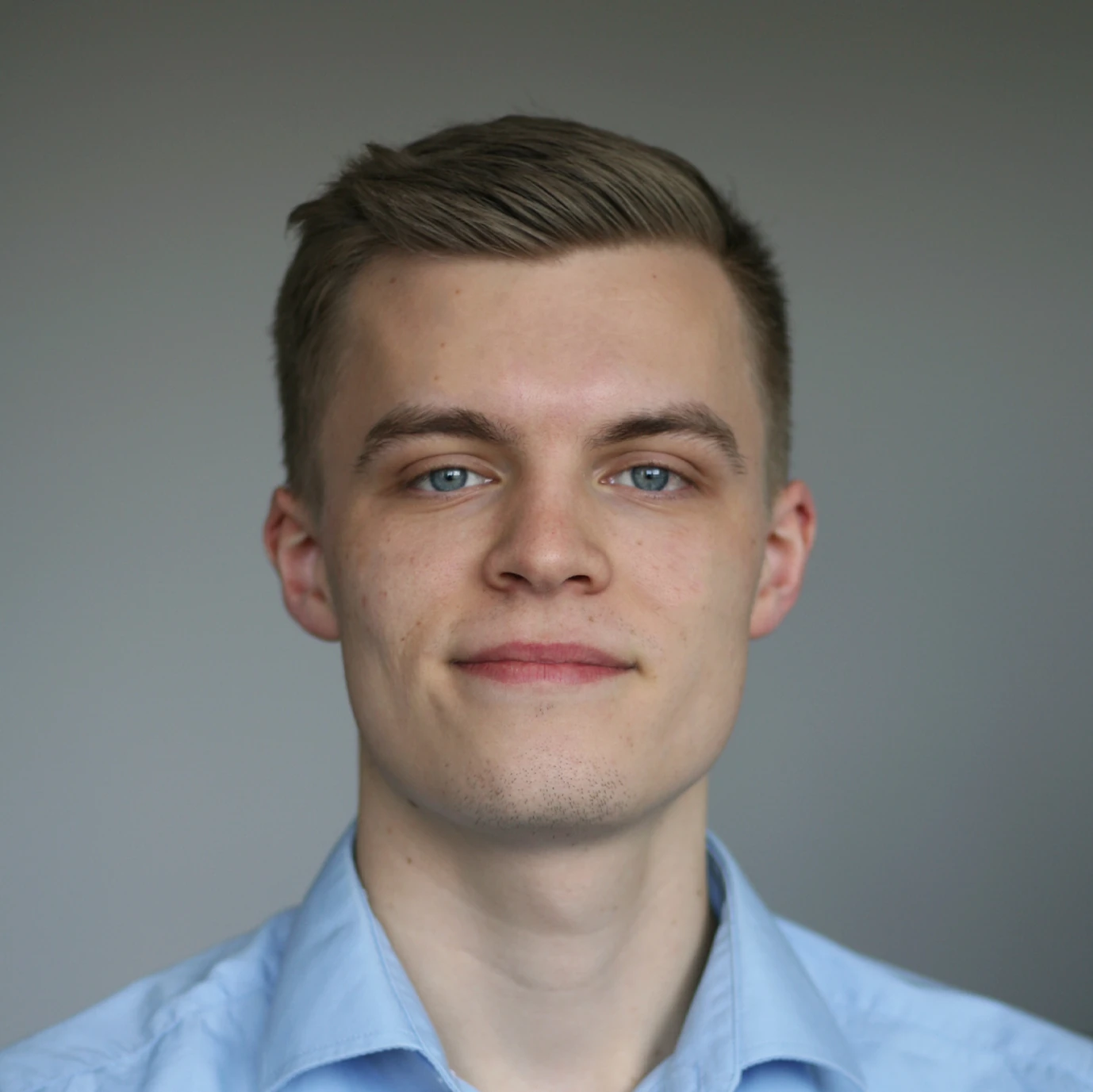
Robin Janssen, M.Sc.

Robin Janssen is a doctoral student in the Computing Systems Group at the Institute of Computer Engineering at Heidelberg University, working in the HAWAII Lab under the supervision of Prof. Dr. Holger Fröning.

His research focuses on understanding and exploiting trade-offs in machine learning systems, particularly at the intersection of hardware and algorithms. He is interested in how constraints such as latency, energy consumption, model complexity, and uncertainty affect predictive performance, and how these competing objectives can be balanced using principled multi-objective optimization methods.

Before starting his PhD in 2025, he studied Physics at Hamburg University (Bachelor’s) and Heidelberg University (Master’s) with a focus on computational physics, machine learning, and numerical methods. His master’s thesis at the AstroAI Lab explored surrogate models for coupled ODE systems in astrochemistry, resulting in the open-source benchmark framework CODES. During his studies, he gained industry experience applying machine learning to embedded computer vision systems at ISRA Vision GmbH and working on semiconductor characterization at Nexperia Germany GmbH.


Research interests

  • Trade-offs in machine learning systems and hardware-aware ML
  • Multi-objective optimization to obtain explore trade-offs in Pareto frontiers
  • Typical trade-offs studied: accuracy vs. latency, energy consumption, uncertainty calibration, and model complexity
  • Energy efficiency for scientific and embedded workloads
  • Uncertainty calibration and robustness
  • Emerging hardware substrates for ML (e.g. photonic computing)

Curriculum vitae

  • Since 2025, PhD candidate in Computer Engineering, Heidelberg University (Germany)
    HAWAII Lab, supervised by Prof. Dr. Holger Fröning
    Research on surrogates and tuning for efficient ML

  • 2022 – 2025, M.Sc. Physics, Heidelberg University (Germany)
    Focus: computational physics, machine learning, numerical methods, statistics
    Thesis: Benchmarking surrogate models for coupled ODE systems
    Developed the open-source benchmark framework CODES (Coupled ODE Surrogates)

  • 2023 – 2025, Working student, ISRA Vision GmbH (Heidelberg, Germany)
    Development and adaptation of machine learning models for embedded computer vision systems
    Applications in anomaly detection and object detection

  • 2021 – 2022, Working student, Nexperia Germany GmbH (Hamburg, Germany)
    Development of a thermal resistance database and experimental characterization of semiconductor devices

  • 2018 – 2022, B.Sc. Physics, University of Hamburg (Germany)
    Electives included high performance computing and instrumentation & data analysis
    Thesis: thermal resistance measurements of semiconductor devices (in collaboration with Nexperia)

Recent Teaching (4-year horizon)

Winter term 2025
Organizer and lecturer
Undergraduate practical “Neural Networks From Scratch”

Publications

Janssen, R., Branca, L., Buck, T.
Systematic selection of surrogate models for nonequilibrium chemistry
Astronomy & Astrophysics (A&A), 2026
arXiv:2603.08567

Storcks, L., Ehlers, G., Janssen, R., Storcks, K., Ameri, T., Buck, T.
Differentiable Interference Modeling for Cost-Effective Growth Estimation of Thin Films
Machine Learning and the Physical Sciences (ML4PS) Workshop @ NeurIPS, 2025
pdf | code

Janssen, R., Sulzer, I., Buck, T.
CODES: Benchmarking Coupled ODE Surrogates
Machine Learning and the Physical Sciences (ML4PS) Workshop @ NeurIPS, 2024
arXiv:2410.20886 | code